When launching a compound-fertilizer business, the first fork in the road is choosing between an NPK granulation line and a BB (bulk-blending) fertilizer line. Both deliver the N-P-K nutrients that crops need, but they serve very different production philosophies. Below is a quick, fact-based comparison to help you decide which route will maximize your ROI.
- Process Complexity & Capital Outlay
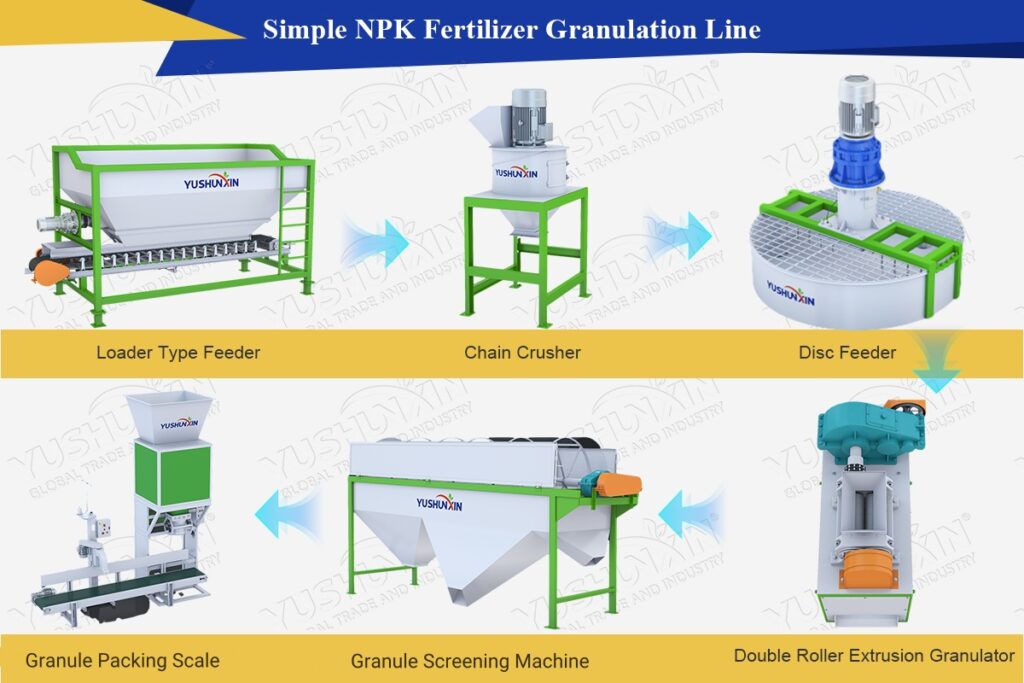
An NPK fertilizer granulation plant mixes powdered chemicals, adds water or steam, granulates, dries, cools, screens and coats. The equipment chain—crusher, mixer, granulator, dryer, cooler, screen, coater—requires 1,000–3,000 m² of workshop and USD 250,000–600,000 for a 10 t/h line .
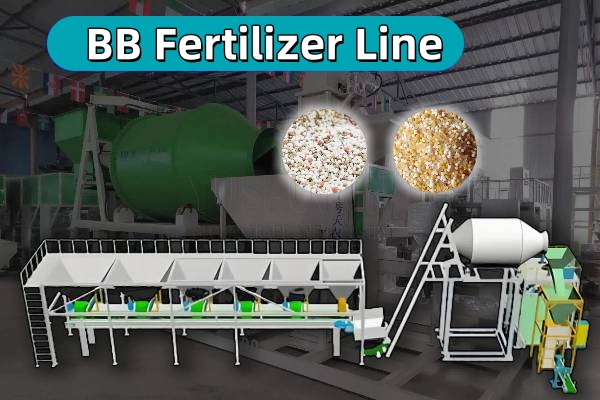
A BB fertilizer plant simply weighs and blends finished granular raw materials such as urea, DAP and MOP. No drying, no granulation, no drying towers. A 10–20 t/h line fits into 500–800 m² and costs USD 80,000–180,000 complete .
- Formula Flexibility
NPK granulation locks the N-P-K ratio inside every granule. Changing from 15-15-15 to 20-10-10 means stopping the line, adjusting feeders, and re-granulating.
BB blending lets you switch formulas in minutes by updating the PLC recipe—ideal for seasonal crops or regional soil prescriptions . - Nutrient Uniformity & Market Perception
Granulated NPK offers perfect intra-granule uniformity, preferred for high-value cash crops and export markets. Additionally, you can also add some other trace elements.
BB fertilizer relies on inter-granule mixing; segregation can occur if raw granules differ widely in size or density. Modern drum mixers keep CV below 3 % when feed particles are 2–4 mm and dry .
- Energy & Operating Cost
Granulation lines consume 25–35 kWh per ton for drying alone. BB lines use only 3–5 kWh per ton for blending and conveying, cutting the utility bill by 70 % . Click here to know more! - Scale-Up Speed
Need 50 t/h tomorrow? Add two continuous BB drum mixers (30 t/h each) and a dynamic belt weigher; total lead time is 6–8 weeks.
Expanding a granulation plant to 50 t/h requires a second dryer, cooler and larger granulator—12–16 weeks plus civil work . - Product Portfolio Strategy
Many successful producers run both: a core NPK granulation line for flagship balanced grades, and a BB satellite plant for fast-turn, custom blends demanded by local cooperatives. The combined CAPEX is still 20 % lower than building two separate granulation trains .
Bottom Line
Choose NPK granulation if you target large-scale, standardized grades and are prepared for higher upfront investment and longer commissioning.
Choose BB blending if you need low entry cost, rapid formula changes, and want to capture the growing “precision agriculture” market that demands tailor-made nutrient ratios.
For most newcomers, starting with a 10–20 t/h BB line generates cash flow in 3–6 months, after which profits can fund a second-phase NPK granulation system—giving you the best of both worlds.
If you need a business plan, welcome to visit: https://www.fertilizerequipmentprice.com/compound-fertilizer-production-line/
Leave a Reply