A small freeze-drying system often works well during the early stage of commercial production. It gives manufacturers a lower entry threshold and enough flexibility for product testing, small orders, and market development.
However, production economics change as order volume grows. More batches, repeated loading, longer waiting time, and rising labor demand can increase the real cost of every kilogram.
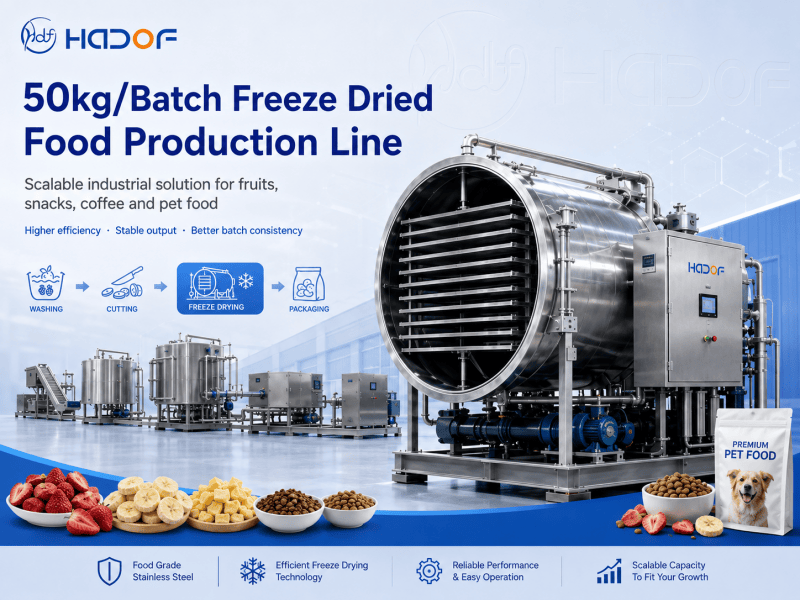
At that point, a 50kg/Batch Freeze Dried Food Production Line can offer a better balance between equipment investment and commercial output.
HADOF can configure the line according to your raw materials, target production volume, and available factory space. The goal is to improve production efficiency without adding unnecessary equipment.
1. When Does Higher Batch Capacity Reduce the Cost per Kilogram?
A small machine may require more production cycles to complete the same order.
Every additional cycle needs preparation, tray loading, freezing, drying, unloading, cleaning, and product transfer. These repeated operations consume labor and production time.
A larger batch system allows the factory to process more material during each cycle. Therefore, the production team can reduce the number of repeated operations for the same total order volume.
This change can lower the labor and handling cost for each kilogram of finished product.
For example, a 30kg/Batch Freeze-Drying Project can support smaller commercial production. However, manufacturers may need more batches when regular orders start exceeding the available production rhythm.
A 50kg/Batch Freeze Dried Food Production Line becomes more attractive when the factory can use the additional batch capacity consistently.
2. How Can a 50kg Line Reduce Repeated Labor?
Labor does not increase only because a factory produces more food.
Batch frequency also affects labor demand.
Operators need to prepare trays, arrange raw materials, manage freezing, load the freeze dryer, unload finished products, and prepare the next cycle. A small machine can repeat these actions more often when order volume grows.
A larger batch system can reduce the number of loading and unloading cycles for the same total production volume.
That difference becomes more important when labor costs rise or when a factory wants to reduce manual handling.
An Industrial Freeze Dryer can form the core of a more organized production system. Supporting equipment can also connect preparation, freezing, drying, and packaging stages more efficiently.
The economic advantage does not come from machine size alone. It comes from fewer repeated operations and better use of labor.
3. Why Does Waiting Time Matter When Production Expands?
Waiting time can quietly increase operating costs.
A freeze dryer may finish one batch while workers still prepare the next batch. In another situation, prepared materials may wait because the freeze dryer has not finished the current cycle.
These gaps reduce equipment utilization.
A 50kg line can improve production rhythm when the surrounding processes match its capacity. The preparation area can organize the next batch while the freeze dryer continues processing the current one.
Factories can also connect freezing and tray preparation more closely with the drying section.
This coordination helps reduce:
- waiting between batches;
- repeated product transfer;
- unnecessary tray handling;
- idle production time;
- workflow interruptions.
A better production rhythm allows the factory to gain more value from the same working day.
4. When Does a 30kg System Start to Limit Commercial Growth?
A 30kg freeze-drying line may remain practical when order volumes fluctuate or when a business still develops its product range.
The situation changes when production becomes regular.
If operators constantly need another batch to complete daily orders, the smaller system may start creating a capacity bottleneck.
The factory may also experience several related problems:
- operators spend too much time on loading and unloading;
- products wait between preparation and drying;
- production schedules become harder to organize;
- overtime increases during busy periods;
- new orders exceed available batch capacity.
In these situations, upgrading capacity can support growth more effectively than simply adding more working hours.
5. Why Can a 50kg Line Offer a Better Middle Stage?
A 50kg line can create a useful transition between smaller commercial production and a larger industrial plant.
It provides more batch capacity without immediately moving the factory into a much larger production system.
This middle stage can help manufacturers increase output while keeping production management relatively simple.
The line can also support future integration with cleaning, cutting, freezing, conveying, and packaging equipment.
For businesses that expect further expansion, a 100kg/Batch Industrial Freeze-Drying Plant offers another step toward larger commercial production.
The 50kg system can therefore serve as a practical upgrade when the 30kg line becomes restrictive but the factory does not yet need a 100kg batch configuration.
6. How Does Better Batch Coordination Improve Equipment Economics?
The freeze dryer should not operate as an isolated machine.
A factory gains more value when preparation capacity, freezing speed, batch loading, drying, unloading, and packaging follow a coordinated rhythm.
For example, upstream equipment should prepare enough raw material before the next drying cycle starts. Downstream equipment should also handle finished products quickly after unloading.
This balance helps prevent one stage from slowing down the entire line.
HADOF can configure the production system according to raw material characteristics, required output, and factory area. This approach helps match the freeze dryer with supporting equipment and available workshop space.
The objective is not simply to increase equipment size. The objective is to improve the cost and efficiency of the complete production process.
When Does the Upgrade Make Economic Sense?
A 50kg/batch system becomes more economical when a smaller line starts creating too many production cycles, repeated labor, waiting time, or scheduling pressure.
The upgrade can help manufacturers process larger orders with fewer repeated operations and smoother batch coordination.
A 50kg/Batch Freeze Dried Food Production Line can therefore provide a stronger commercial production platform when demand grows beyond the practical rhythm of a smaller system.
The right upgrade depends on the complete workflow rather than batch capacity alone. HADOF can match the production line with your raw materials, target production capacity, and available factory space.
If you need a customized freeze-drying production solution, please visit the HADOF Freeze Dryer homepage for more information: https://www.freezehadof.com/
Leave a Reply