A food equipment buyer who imports garlic machinery for a peeling plant, a dehydrated garlic factory, or a seasoning manufacturer needs to understand where the export market moves before placing an order. The china garlic processing equipment export trends 2026 point toward deeper processing, stronger automation, and stricter compliance, and each trend changes what a buyer should request in a quotation. This article explains the demand drivers, the key markets, the technology shift, and the supplier checks that protect a food processing investment.
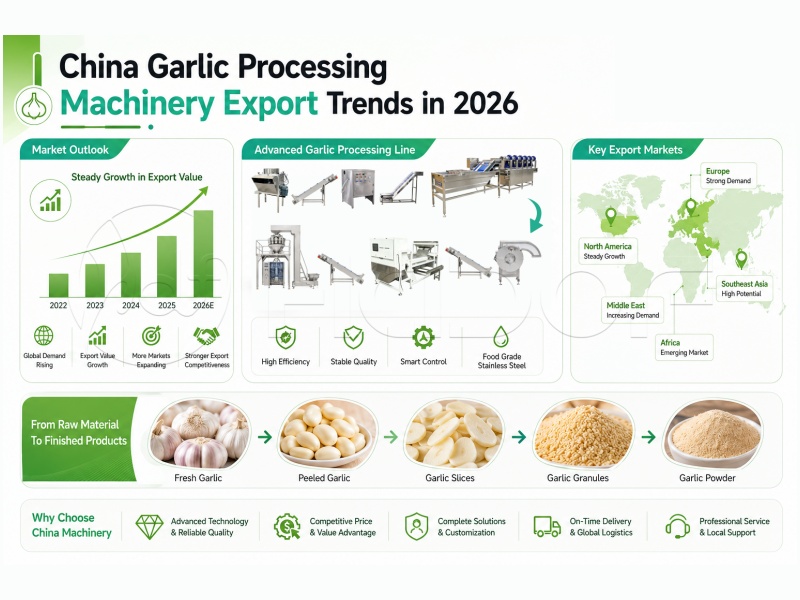
What Drives Garlic Processing Machinery Export Growth in 2026?
Dehydrated garlic production and garlic powder manufacturing push most of the current demand, because the dehydrated garlic market grows strongly and reaches several billion dollars in value this year. Buyers therefore request garlic peeling machines, slicing machines, drying equipment, and packaging machines that feed a continuous line. Garlic extract processing, garlic oil extraction, and allicin separation also expand quickly, which moves export demand toward deeper garlic processing systems. The china garlic processing machinery export growth for food buyers reflects this shift from basic peeling toward complete drying and freezing solutions. A buyer who watches this shift can plan equipment that serves a growing product category instead of a shrinking one.
Where Do Key Export Markets and Investment Opportunities Appear?
Demand spreads across Southeast Asia, South America, Europe, Africa, and North America, and each region buys for a different reason. Customers in Indonesia, Thailand, and Vietnam increase purchases because regional trade gives them a cost advantage, while India and Egypt expand garlic production capacity and processing investment. European and North American buyers evaluate total investment more carefully, and they compare garlic machinery quotations against food-grade construction and after-sales support. A buyer who knows which market it serves can match the machine to the local labor, power, and service conditions. That regional view protects the food cost of a garlic project before the first container ships.
How Do Automation and Integrated Lines Shape Garlic Machinery Technology?
Three trends now define the equipment: automation inside garlic processing production lines, integrated line solutions, and energy-efficient drying and freezing technology. The garlic processing equipment suppliers from china for 2026 increasingly offer a complete flow that joins peeling, washing, slicing, drying, and packing, so a buyer no longer assembles the line from scattered machines. Automated controls reduce operator count and make output repeatable, while hot air drying and freeze drying cut the energy that a dehydrated garlic line consumes. A buyer who asks for an integrated quotation therefore gets a food manufacturing system rather than a list of separate prices.
How Do Compliance and Service Requirements Affect Equipment Buyers?
Europe and North America require CE-certified garlic machinery and food-grade stainless steel equipment, so compliance changes both the machine and the supplier decision. A buyer verifies the stainless steel grade, the electrical protection, and the documentation before the order, because a missing certificate can block clearance at the port. Local service support, spare parts, and training also matter, since a peeling or drying line must keep running through the harvest season. The supplier that documents quality control gives a buyer a safer food safety position. These checks belong in the food machinery selection as much as the purchase quotation.
How Does a Garlic Peeling and Drying Line Fit a Food Factory Project?
A complete complete garlic peeling and drying line for food factories turns whole bulbs into peeled cloves, slices, or powder, and the line layout decides how much labor and floor space the project needs. A medium factory often starts with a peeler and washer, then adds slicing or drying according to the finished product, so the line can grow with demand. Each machine feeds the next, and a matched capacity keeps the flow steady without hand transfer. A buyer who plans the line as one food processing system avoids buying a fast peeler that feeds a slow dryer, and that planning protects the project budget.
How Should Buyers Evaluate China Garlic Machinery Suppliers?
Garlic production and trade depend on seasonal volume, so a buyer needs a supplier that can deliver on time and support the line after installation. You can review the garlic processing equipment manufacturer background before a purchase, and that review shows workshop scale, export experience, and quality control. A careful buyer asks for a trial with its own garlic, a clear spare parts list, and a written training plan. These steps turn a food investment from a catalogue choice into a dependable production decision.
Conclusion
China garlic processing equipment export trends in 2026 reward buyers who follow dehydrated garlic and powder demand, compare regional markets, request integrated and energy-efficient lines, and verify compliance and service. These checks protect a garlic project from late delivery and hidden operating cost. If you have interests, you can learn more about https://www.hadofps.com/news/china-garlic-processing-machinery-export-trends-in-2026/
Leave a Reply