In modern fertilizer manufacturing, every investor expects to control the organic fertilizer production plant cost while maintaining high product quality. The fertilizer plant setup cost mainly depends on the selection of raw materials, production technology, and equipment configuration. An efficient organic fertilizer granulation process not only reduces waste but also improves granule uniformity and market competitiveness. This article discusses suitable materials for organic fertilizer powder and granule production, details key fertilizer machines, and analyzes how to build a cost-effective fertilizer manufacturing line for sustainable business growth.
What Raw Materials Can Ensure Stable Organic Fertilizer Production Quality and Lower Plant Cost?
The choice of raw materials directly determines the organic fertilizer plant cost and the quality of final granules. Common materials in organic fertilizer powder production include livestock manure, poultry droppings, crop straw, mushroom residue, biogas residue, and kitchen waste. These sources provide sufficient organic matter and nutrients for granule-making. When investors select locally available and low-cost materials, the overall fertilizer manufacturing plant cost decreases significantly because transportation and preprocessing requirements reduce.
For example, chicken manure and cow dung contain high nitrogen, while crop straw supplies carbon, which balances the C/N ratio during organic fertilizer fermentation. A well-adjusted compost mixture forms the basis for efficient organic fertilizer granulating. During the organic fertilizer preparation process, the composting stage transforms waste into stable humus, offering excellent granulation performance and improving fertilizer structure. Therefore, consistent resource utilization and rational raw material mixing ensure both economic and environmental benefits.
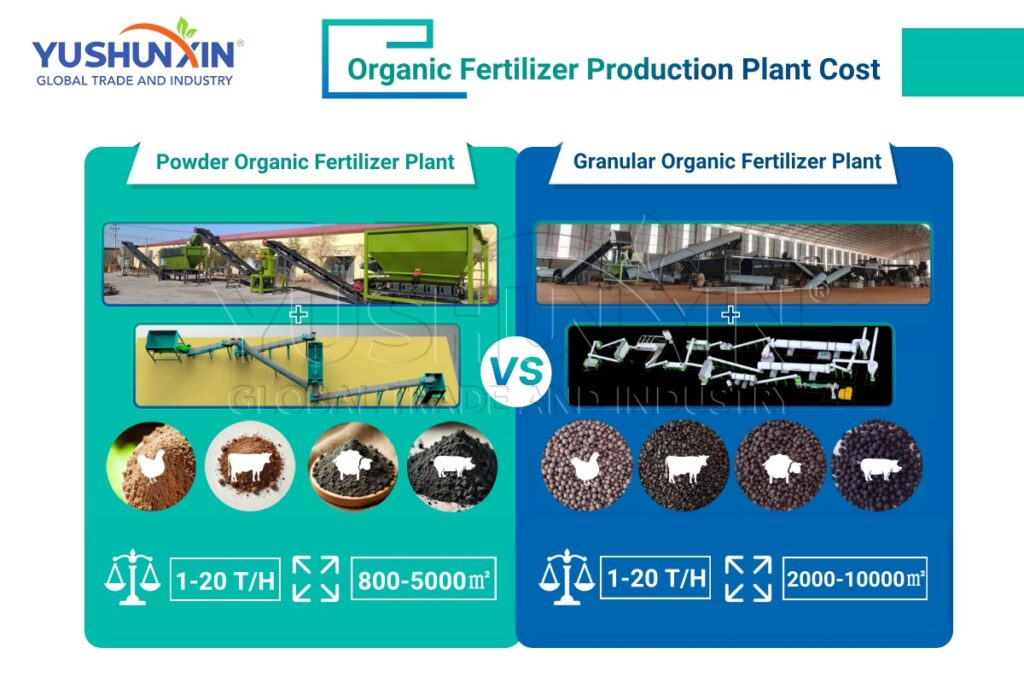
How Do Key Organic Fertilizer Machines Improve Efficiency and Reduce Fertilizer Plant Setup Cost?
The configuration of equipment influences project investment and operation cost. In an organic fertilizer production line, the main machines often include a compost machine, crushing machine, granulator, rotary drying machine, and screening machine. Each type of equipment takes an important role in the fertilizer production process, and the correct combination ensures stable capacity and lower organic fertilizer production plant cost.
A groove type compost turner or wheel type compost machine accelerates fermentation and saves labor. After composting, a crushing machine such as a vertical crusher refines materials into uniform powder before granulating. In the granulation section, investors can choose a disc granulator, double roller extrusion granulator, or new type organic fertilizer granulator according to raw material features. A disc granulator provides low energy consumption and flexible particle size adjustment, while a double roller granulator suits small-scale fertilizer pellet making with low investment. A rotary dryer and screening machine help control moisture and classify granule sizes, ensuring stable appearance and quality. Through proper equipment selection, the fertilizer factory cost achieves balance between production efficiency and reliability.
How to Build a Cost-Effective and Sustainable Organic Fertilizer Granulation Plant?
To maximize return on investment, each producer needs to design a fertilizer manufacturing line with reasonable capacity, energy efficiency, and automation level. When the production scale matches local raw material supply, the fertilizer plant cost stays under control. Automated feeding, batching, and granule-drying systems reduce labor expenses and improve continuous operation capability. Moreover, adopting advanced organic fertilizer granulating technology improves granule density and reduces reprocessing loss.
Regular equipment maintenance keeps machines operating steadily, preventing unexpected downtime and extra energy consumption. Investors also should consider long-term cost factors such as spare parts supply and technical support. A reliable manufacturer provides integrated solutions covering design, installation, and training, which minimizes future maintenance cost. In this way, the organic fertilizer production procedure becomes both economical and environmentally friendly.
Conclusion
A cost-effective organic fertilizer granulation project depends on proper raw material choice, efficient production technology, and high-quality machinery. From composting to granule drying, every stage influences cost control and product value. Investors who focus on optimizing the organic fertilizer production process gain stable output and faster return. Among global solution providers, a professional fertilizer equipment manufacturer – Yushunxin offers complete organic fertilizer production lines and customized support to help clients reduce organic fertilizer plant cost while improving production efficiency and granule quality. Through scientific planning and reliable equipment, sustainable fertilizer business success becomes achievable. You can visit: https://www.fertilizerproductequipment.com/organic-fertilizer-production-plant-cost/
Leave a Reply